

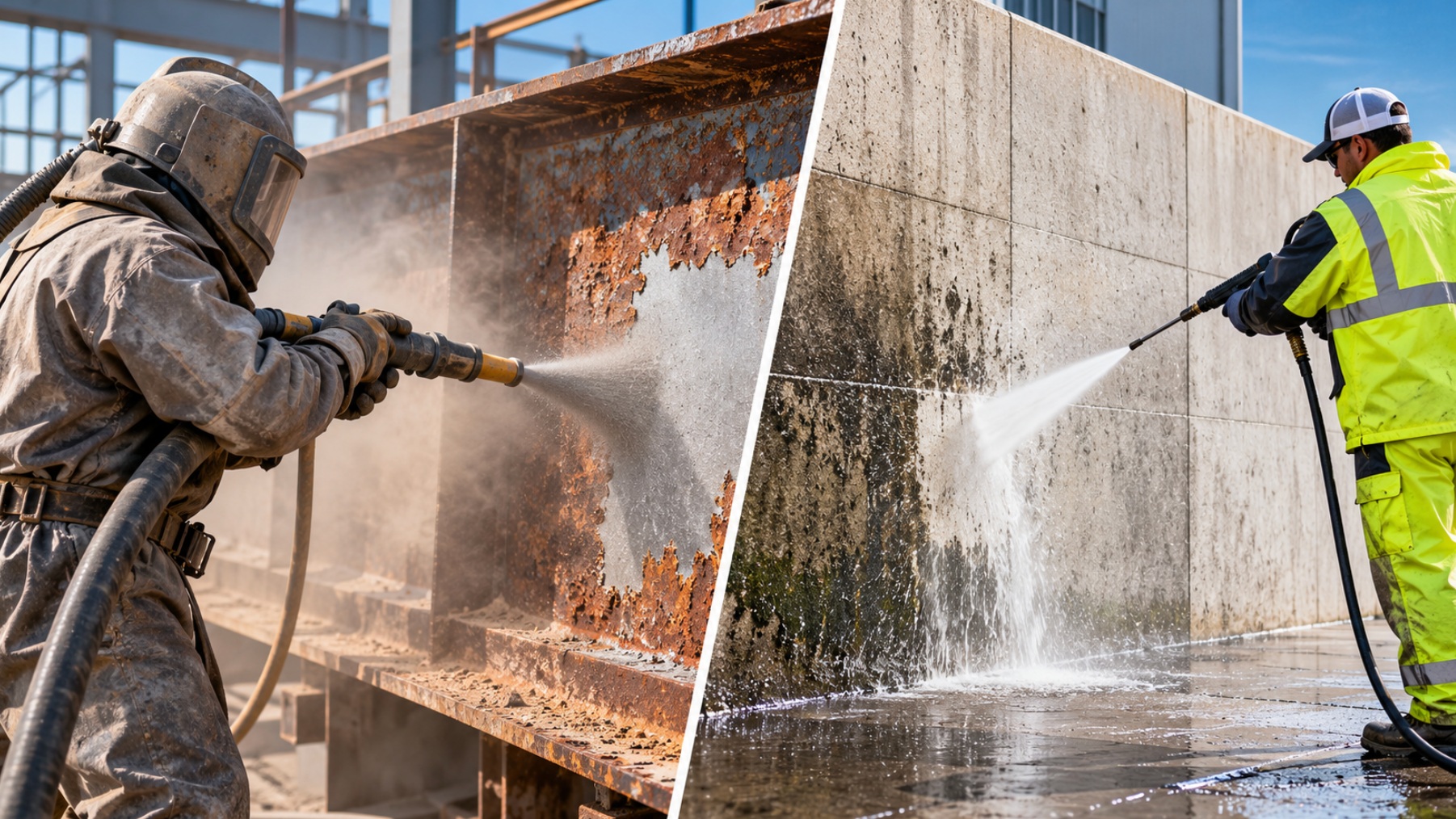
Property owners and facility managers preparing a surface for a new coating often face the same question: sandblasting or pressure washing? Both methods clean, but they work in different ways and suit different problems. Understanding how each one performs helps you choose the right approach for your surface, your budget, and the condition of the material you’re working with.
Understanding Sandblasting and Pressure Washing
Sandblasting, also called abrasive blasting, propels sand or another abrasive media at high speed to strip a surface down to bare material. It’s a mechanical process that removes paint, rust, mill scale, and old coatings while also roughening the surface so a new coating has something to grip. Pressure washing, by contrast, relies on high-pressure water rather than abrasive media. It’s effective at lifting dirt, grease, mildew, and general grime from a surface without altering the material underneath. Both are legitimate surface preparation methods; the right one depends entirely on what’s actually on the surface and what condition it needs to end up in.
How Sandblasting Removes Stubborn Surface Contaminants
Sandblasting earns its reputation on jobs where a surface needs more than a clean, it needs to be reset. Cured paint, rust, and factory coatings bond tightly to metal and masonry, and water alone can’t break that bond. Abrasive media cuts through these layers mechanically, exposing bare substrate and leaving behind a textured surface profile that improves coating adhesion. This makes sandblasting a common choice ahead of repainting metal structures, machinery, and equipment that will face high heat or heavy wear. Diotte Coating Services offers sandblasting services as part of its industrial painting work in the Toronto area, including metal painting, machinery painting, and high-heat and heatproof painting applications where a properly profiled surface matters for long-term results.
The Benefits and Limitations of Pressure Washing
Pressure washing is a fast, practical option when the goal is cleaning rather than stripping. It handles dirt, mildew, algae, and general surface buildup well, and hot water pressure washing adds the ability to break down grease and oil that cold water struggles with. Because it doesn’t rely on abrasive media, it’s gentler on surfaces that don’t need to be taken back to bare material. That gentleness is also its limitation: pressure washing cannot remove cured paint, rust scale, or bonded coatings. It’s also worth noting that excessive water pressure can damage softer masonry, worn mortar joints, or aging surfaces, so the pressure and technique need to match the material. Diotte Coating Services includes pressure washing as part of its surface preparation offering for projects where cleaning, not stripping, is the objective.
Key Differences Between Sandblasting and Pressure Washing
The clearest way to compare sandblasting vs pressure washing is by what each one is actually capable of removing. Pressure washing cleans; it does not strip bonded coatings or rust. Sandblasting strips; it removes material down to bare substrate and leaves a profiled surface behind. Cost considerations follow the same logic: pressure washing is generally the simpler, faster process, while sandblasting involves more setup, containment, and material recovery, reflecting the more intensive work it performs. Potential for damage runs in both directions. Sandblasting is an abrasive process that can harm delicate or soft surfaces if the media or pressure isn’t matched correctly, while pressure washing at too high a setting can erode mortar, strip sealants, or damage weathered masonry. Neither method is universally better; each is suited to a different type of contamination and a different surface condition.
Choosing the Right Cleaning Method for Different Surfaces
Surface material plays a major role in deciding between the two methods. Concrete can typically tolerate either approach, though sandblasting is usually reserved for removing coatings, efflorescence, or heavy staining, while pressure washing handles routine dirt and grime. Brick and masonry call for caution either way: sandblasting can wear down soft or historic brick, and high-pressure water can erode mortar joints, so a measured approach matters on these surfaces. Metal surfaces destined for a new protective coating generally benefit from sandblasting, since it removes rust and old paint while creating the profile a coating needs to bond properly. For equipment, siding, and exterior surface cleaning where the goal is simply removing accumulated dirt or grime without affecting the substrate, pressure washing is usually the more practical choice. In every case, the right method depends on the surface condition, the coating involved, and what the project is actually trying to achieve.
Professional Surface Preparation and Cleaning
Choosing between sandblasting and pressure washing isn’t always straightforward, especially on projects involving older coatings, mixed materials, or surfaces heading into a repaint. Diotte Coating Services has provided industrial painting and surface preparation services to businesses in the Toronto area for nearly two decades, working on metal painting, machinery painting, and high-heat painting projects where getting the prep method right affects how long the finished coating lasts. Readers who want guidance on which surface preparation approach fits their project are welcome to reach out directly.
Frequently Asked Questions (FAQs):
Q. Can sandblasting damage a surface?
A. Yes, sandblasting is an abrasive process, and the wrong media or pressure setting can damage delicate materials, thin metal, or soft masonry. That’s why the media type and pressure are matched to the surface and the coating being removed. On the right surface, properly controlled sandblasting removes contaminants without harming the underlying material.
Q. Can pressure washing damage brick or masonry?
A. It can, if the pressure is set too high for the material. Soft brick, aging mortar, and weathered masonry are especially vulnerable to erosion from excessive water pressure. Using the correct pressure setting and nozzle technique allows pressure washing to clean these surfaces effectively without stripping away material or widening mortar joints.
Q. Will pressure washing remove old paint or rust?
A. Generally not on its own. Pressure washing is effective against dirt, grease, and mildew, but cured paint, rust scale, and bonded coatings require the mechanical stripping action of sandblasting. If the goal is a bare surface ready for recoating, sandblasting is typically the more appropriate method.
Q. Is sandblasting necessary before every repainting project?
A. Not always. Sandblasting is most useful when a surface has existing coatings, rust, or scale that need to be removed before a new coating is applied. If a surface is already clean and sound, with no bonded contaminants, pressure washing or a lighter cleaning method may be sufficient preparation.
Q. How do I know which method is right for my surface?
A. The right choice depends on what’s on the surface, the surface material itself, and the project’s end goal. Dirt, grime, and mildew point toward pressure washing. Paint, rust, or coatings that need full removal point toward sandblasting. A professional assessment of the surface condition is the most reliable way to decide.
Q. Does Diotte Coating Services offer both sandblasting and pressure washing?
A. Yes, Diotte Coating Services provides both sandblasting and pressure washing as part of its surface preparation and industrial painting services in the Toronto area, alongside metal painting, machinery painting, and high-heat painting work for commercial and industrial clients.